
In certain situations, it is necessary to trigger ventilation strokes individually as required. In emergency medicine, this is particularly the case for CPR and Rapid Sequence Induction (RSI).
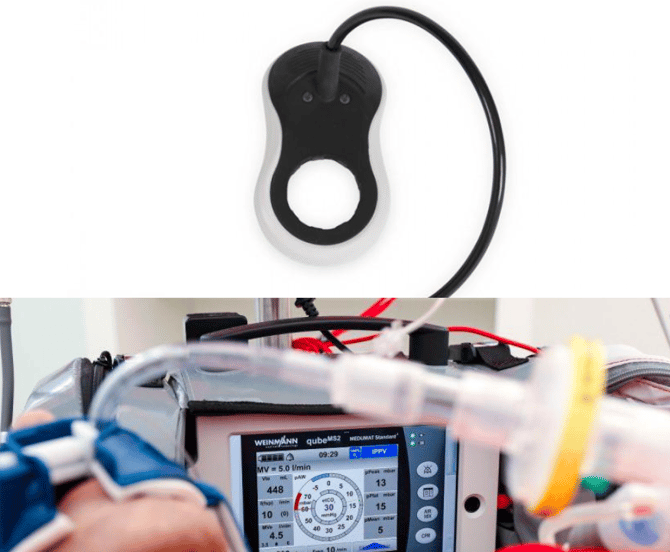
With the new qubeTRIGGER, SKILLQUBE makes this possible for simulated mechanical ventilation.
The qubeTRIGGER is available for the qubeMS2, which is attached directly to the mask and connected to the simulator by an electrical line.
Connect qubeTRIGGER
iPad mini ab Generation 6
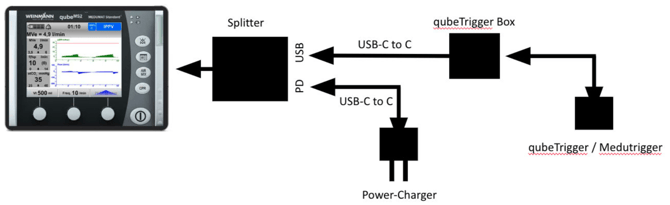
The qubeTRIGGER is connected via the charging port of the iPad mini. To do so, plug the USB-C splitter into the iPad as shown in the schematic instructions. You may now connect the charger (via the “PD” port) and the qubeTRIGGER (via the “USB” port) to the splitter. If you do not want to charge the iPad simultaneously, the qubeTRIGGER can be connected directly to the iPad using the USB-C cable. If the qubeMS2 Software is running and the manual CPR mode is active, the complete functionality is available.
iPad mini Generation 5
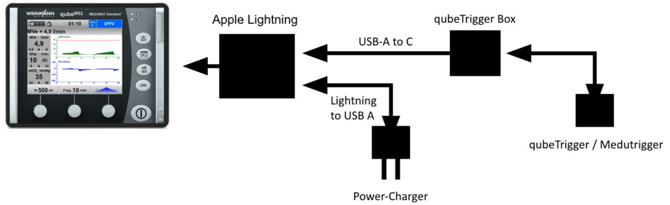
The qubeTRIGGER is connected via the charging port of the iPad mini. To do this, plug the Apple Lightning to USB adapter into the iPad as shown in the schematic instructions. The charger and the qubeTRIGGER can now be plugged into the splitter. If the qubeMS2 Software is running and the manual CPR mode is active, the complete functionality is available.
Note:
The qubeTRIGGER is recognized by the iPad as a keyboard. This means that the keyboard is not automatically opened on the screen when writing in a text field. To show the keyboard, click on the keyboard icon at the bottom of the screen and select “show keyboard”. Alternatively, unplug the qubeTRIGGER to automatically display the keyboard again.
Using qubeTRIGGER
- The ventilation strokes are triggered by pressing the black button on the qubeTRIGGER. When pressed longer, two ventilation strokes are triggered in succession in accordance with the guidelines (30:2)
- When triggering ventilation strokes with the qubeTRIGGER, the user can simultaneously seal the mask with the two-handed C-Grip. This way, only one user is needed to safely ventilate the patient.